```json
{
"text": "
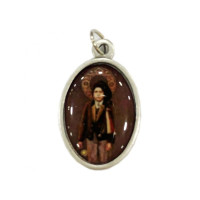
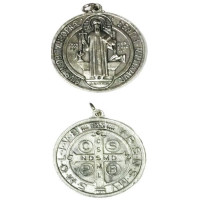
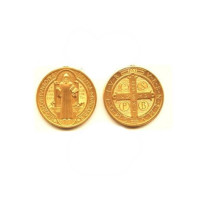
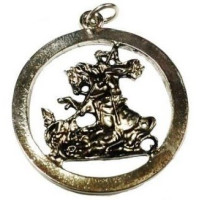
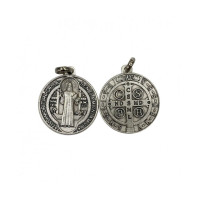
St. George medal (metal)
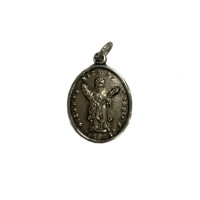
The St. George medal (metal) has a diameter of 1.5 cm and features a three-dimensional relief image of the Saint embedded in a metal ring.
About St. George
Although there is limited historical information about St. George, this warrior saint is believed to have been born in ancient Cappadocia, an area now part of the Republic of Turkey. After his father's death in battle, he moved to Palestine with his mother.
His mother, Lida, from a wealthy family in Palestine, provided him with a good education. As a teenager, he joined the military and was quickly promoted to captain of the Roman army due to his zeal, dedication, courage, mastery, and tactical and military skills. These qualities led the emperor to grant him the title of Count of the province of Cappadocia. At 23, he took on the role of Military Tribune in the imperial court in Nicomedia. During this period, his mother passed away, and George, inheriting her substantial wealth, moved to the court of Emperor Diocletian.
In 302, Emperor Diocletian issued an edict ordering the arrest of all Christian Roman soldiers and forcing all soldiers to swear allegiance to Roman gods. St. George confronted the emperor with his objections and publicly declared himself a Christian. Not wanting to lose one of his best tribunes, the emperor tried to dissuade him by offering land, money, titles, and slaves. However, facing George's unwavering stance, the emperor ordered him to be tortured to make him renounce his faith. But after each torture session, George reaffirmed his faith and devotion, gaining notoriety among the Romans. His willpower and faith became so distinct and renowned that even the emperor's wife converted to Christianity in the face of his suffering. Emperor Diocletian, seeing his efforts and will thwarted, ordered George beheaded on April 23, 303, in Nicomedia. St. George's remains were transported to Lida, the city where he grew up with his mother. There he was buried, and later, Emperor Constantine, a Christian emperor, commissioned a grand oratory for all believers to pay homage and devotion to the saintly warrior, helping to spread the legend of St. George.
"
}
```










Comments (0)
Your review appreciation cannot be sent
Report comment
Report sent
Your report cannot be sent